A UV Index of 0 means there is no measurable ultraviolet radiation reaching the Earth’s surface at that location and time. You’ll see this reading every night after sunset, during total solar eclipses, or occasionally when checking your weather app indoors if the sensor is blocked. It’s not an error or malfunction. It simply indicates the complete absence of UV rays capable of affecting human skin.
Understanding what 0 actually represents matters more than you might think. Most of us glance at UV Index readings without questioning the science behind them, but that zero carries specific meaning about atmospheric conditions, sun position, and measurement thresholds. Unlike a low UV Index of 1 or 2, which still indicates trace amounts of ultraviolet radiation, zero is absolute. No sunscreen needed, no risk of sunburn, no vitamin D production happening naturally.
The confusion around this reading is understandable. We’re used to thinking of UV exposure as something that varies by degree throughout the day, fading gradually as the sun sets. But the UV Index works in whole numbers, and its calculation involves complex atmospheric modeling, not just direct sunlight measurement. When the sun dips below the horizon or thick cloud cover blocks all UV wavelengths, the index doesn’t inch toward zero. It simply becomes zero.
This article breaks down exactly how UV Index measurements work, what conditions produce that 0 reading, and why understanding the difference between zero and low UV levels helps you make smarter decisions about sun protection year-round.
What a 0 UV Index Really Means
A 0 UV Index reading means there is no measurable ultraviolet radiation reaching the Earth’s surface at levels that could cause skin damage. It’s the baseline of the UV Index scale, indicating that your skin won’t produce vitamin D, won’t tan, and won’t burn during that time, regardless of how bright or warm it feels outside.
You’ll encounter a 0 reading most commonly after sunset and before sunrise, when the sun sits below the horizon and its rays no longer reach your location. The atmosphere scatters and absorbs the already-weakened UV radiation, leaving none to detect at ground level. During polar winters, residents experience 0 UV Index readings for weeks or even months as the sun never rises above the horizon. Some heavily overcast conditions can also produce a 0 reading, though this is less common than you might expect, most thick cloud cover still allows trace amounts of UV to filter through, registering as a 1 on the scale.
To understand what the numbers actually represent, a few technical terms help:
UV Index
A simplified scale from 0 to 11+ that communicates UV radiation intensity in terms of skin damage risk, designed for public health communication rather than precise scientific measurement.
Erythemally weighted irradiance
The actual physical measurement underlying the UV Index, expressed in watts per square meter and weighted toward wavelengths that cause sunburn (erythema).
Minimum threshold
The lowest level of UV radiation at which the index rounds up to 1, typically around 0.025 watts per square meter of erythemally weighted irradiance.
Sensor detection limit
The smallest amount of UV radiation a measurement instrument can reliably distinguish from background noise, which varies by equipment quality and calibration.
Indoor readings of 0 confuse many people checking weather apps. Glass windows block most UV-B radiation (the primary sunburn wavelength), so even a sunny room registers 0 on UV sensors. This doesn’t mean there’s no sunlight, visible light and infrared heat pass through easily, just no meaningful UV exposure. Similarly, a 0 reading doesn’t indicate complete darkness or the total absence of solar radiation. It specifically tells you that UV levels have dropped below the threshold where your skin would react, which is the practical information the scale was designed to convey.
How UV Index and Irradiance Are Measured
At night, environmental lighting can still be visible, but there’s no measurable UV reaching the skin-damaging wavelengths.
The UV Index Scale
The UV Index translates raw ultraviolet irradiance measurements into a standardized 0-11+ scale that anyone can understand at a glance. To create this scale, scientists take the spectral irradiance at each UV wavelength and multiply it by an “erythema action spectrum”, essentially a weighting function that accounts for how much each wavelength damages human skin. Shorter UV-B wavelengths get heavier weight because they cause sunburn more efficiently than longer UV-A wavelengths.
The weighted irradiance values are summed, then multiplied by 40 to produce the final index number. An irradiance of 25 milliwatts per square meter of erythemally-weighted UV equals a UV Index of 1. Below that threshold, the index rounds down to 0.
Zero represents the scale’s floor because negative UV radiation doesn’t exist in nature, you either have measurable skin-damaging UV reaching the surface or you don’t. The scale caps categories at 11+ (extreme), though measurements occasionally exceed 15 in high-altitude tropical locations during summer. This simplified numbering system turns complex spectral data into a single figure that tells you whether you need sunscreen, not whether you need a physics degree.
Solar Irradiance Measurement
Spectroradiometers measure UV radiation by separating incoming sunlight into its component wavelengths, creating a detailed spectral fingerprint. These instruments can distinguish UV-B (280-315 nm) from UV-A (315-400 nm) with precision, capturing the exact energy at each nanometer. Think of them as prisms that not only split light but also count the photons in each color band.
Broadband sensors take a simpler approach. They use filters to isolate the entire UV range and measure total energy in watts per square meter, without breaking it down by wavelength. While less detailed, they’re more practical for continuous monitoring at weather stations.
Here’s something curious: irradiance never truly reaches absolute zero, even at midnight. Atmospheric scattering bounces a tiny fraction of sunlight from the daylit side of Earth, and instruments themselves generate minuscule electrical noise that registers as faint signal. Modern sensors might detect 0.0001 W/m² when the UV Index rounds to 0, technically not zero, but so negligible that your skin couldn’t possibly notice. The UV Index, designed for public health rather than laboratory precision, sensibly treats these trace amounts as functionally zero.
Components of UV Measurement Systems
When your weather app displays a 0 UV Index reading, that number represents the end result of a complex chain of measurements and calculations. Understanding the components behind UV detection reveals why a 0 appears and what physical conditions make it happen.
The foundation of UV measurement starts with specialized sensors. Ground-based spectroradiometers serve as the gold standard, these instruments break incoming sunlight into its constituent wavelengths, measuring UV-A (315-400 nm) and UV-B (280-315 nm) separately with precision down to fractions of a nanometer. A typical meteorological station uses a broadband UV sensor, which is less expensive but captures the UV spectrum as a whole rather than wavelength by wavelength. These ground sensors sit in open locations, calibrated against reference standards, and take readings every few minutes throughout the day. When the sun drops below the horizon, these sensors detect no UV photons reaching their detectors, which feeds into the calculation that produces a 0 reading.
Satellite-based instruments provide the second layer of measurement. NASA’s Ozone Monitoring Instrument and similar sensors aboard weather satellites scan the Earth’s surface, measuring backscattered UV radiation and total ozone column amounts. These satellites can’t measure UV at ground level directly, they observe from space and use atmospheric models to estimate what reaches the surface. During polar winter or nighttime passes, satellites confirm the absence of solar UV input, supporting the 0 UV Index forecast.
Personal UV monitors have entered the market in recent years, embedded in wearables and smartphone accessories. These tiny photodiodes respond to UV wavelengths, though with less accuracy than research-grade equipment. They’re useful for real-time exposure tracking but can show slight variations from official forecasts due to calibration differences and local shading.
The raw sensor data doesn’t translate directly into UV Index. Several atmospheric inputs modify how much UV survives the journey from space to your skin:
Spectroradiometers and broadband sensors that detect UV wavelengths at ground level
Erythemal action spectrum weighting, which emphasizes the wavelengths most damaging to human skin
Ozone absorption modeling that accounts for stratospheric ozone blocking most UV-B
Cloud attenuation factors, since thick clouds can reduce surface UV by 50-90%
Ground albedo correction for reflective surfaces like snow or sand that bounce UV upward
Calculation models tie everything together. The standard formula takes irradiance measurements in watts per square meter, applies the erythemal weighting (which peaks around 300 nm where skin damage is greatest), and multiplies by 40 to produce the familiar 0-11+ scale. During nighttime, this calculation receives zero input from sensors, no photons, no irradiance, no weighted sum. The model outputs 0. Thick storm systems or volcanic ash clouds can similarly block enough UV during daytime that calculated values round down to 0, though this is rare except near twilight.
Altitude and latitude feed into forecast models as well. UV intensity increases roughly 10% per kilometer of elevation because there’s less atmosphere to filter radiation. A 0 reading at sea level during early evening might correspond to a 1 at a mountain observatory where scattered light lingers. Geographic latitude determines sun angle, which affects how much atmosphere sunlight must penetrate, polar regions see extended periods of 0 UV Index during winter months when the sun never rises.
When and Where You’ll See a 0 UV Index
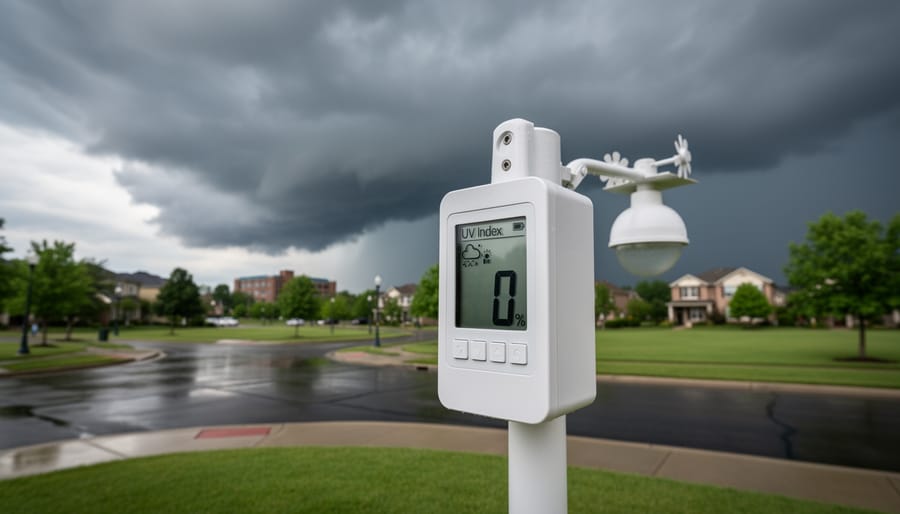
Heavily clouded or stormy conditions can reduce UV exposure so dramatically that the UV Index may read as zero.
You’ll encounter a 0 UV Index reading most predictably after sunset. Open your weather app at midnight anywhere on Earth, and you’ll see 0, no sunlight means no ultraviolet radiation reaching the surface. This holds true whether you’re in New York, Tokyo, or Sydney. The sun’s absence makes 0 the universal nighttime baseline.
Polar regions during winter offer another straightforward scenario. In places like Barrow, Alaska, or Svalbard, Norway, the sun doesn’t rise above the horizon for weeks or months during polar night. Throughout this extended darkness, UV Index remains locked at 0. Residents experience 24-hour twilight at best, with no direct solar radiation capable of triggering a higher reading.
Dense storm systems can occasionally push daytime readings to 0, though this requires exceptional cloud thickness. A severe thunderstorm with multiple cloud layers, heavy precipitation, and dark conditions might block enough UV-B radiation that sensors register nothing measurable. This happens rarely, most overcast days still show UV Index values of 1 or 2, but it’s possible in extreme weather.
Deep valleys surrounded by tall mountains can create localized 0 readings during winter, particularly in high-latitude regions. When the sun’s low angle keeps direct rays blocked by terrain for the entire day, and when snow-covered slopes reflect minimal scattered UV into the valley floor, you might see 0 persist through daylight hours.
Industrial pollution occasionally contributes to 0 readings in heavily polluted cities, though modern air quality has made this uncommon. Thick smog can scatter and absorb UV radiation before it reaches ground-level sensors.
The twilight discrepancy you notice between apps stems from sensor sensitivity and rounding practices. Some platforms register trace UV during dawn or dusk and round up to 1, while others apply a stricter threshold and report 0 until measurable UV-B appears. Both approaches are valid, the practical difference for sun protection remains negligible either way.
Why UV Index Differs from Total Sunlight
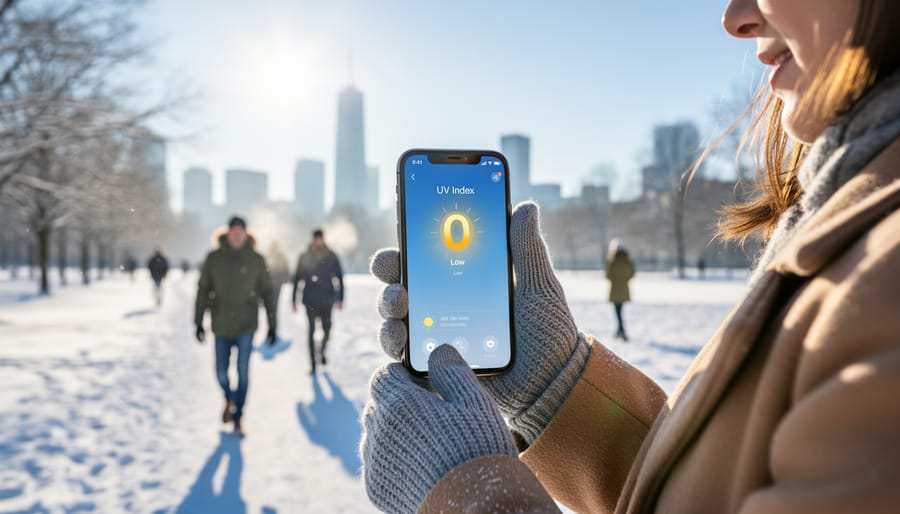
Even when daylight feels strong, especially in winter, UV can still be absent or negligible, leading to a UV Index of zero.
Sunlight isn’t a single type of radiation, it’s a mix of different wavelengths bundled together, and UV represents only a tiny fraction of what reaches Earth. Think of it like a symphony where UV radiation is just one instrument section among many. When the UV Index hits 0, you’re essentially muting that one section while the rest of the orchestra keeps playing. The solar spectrum includes visible light (what we see), infrared (what we feel as heat), and ultraviolet radiation, each occupying distinct wavelength ranges. UV-A and UV-B together make up less than 10 percent of the sun’s energy output at Earth’s surface, while visible and infrared dominate.
This explains why you can step outside after sunset, see your surroundings clearly, and feel warmth on your skin even though your weather app shows a 0 UV Index. The visible wavelengths still illuminate your environment, and infrared radiation continues to transfer heat. Understanding how sunlight forms helps clarify why these wavelengths behave independently, they originate from the same nuclear fusion in the sun’s core but interact differently with our atmosphere and skin.
The practical takeaway matters for daily decisions. You won’t need sunscreen at a 0 UV Index because the specific wavelengths that damage DNA in skin cells are absent, but you might still want sunglasses for glare or light clothing if it’s warm. A 0 reading doesn’t mean total darkness or cold, it means the slice of the spectrum that causes sunburn has dropped below measurable levels. The rest of the sun’s energy keeps doing what it always does.
How a 0 UV Index Is Used in Daily Life and Research
A zero UV Index reading serves as more than just a data point on your weather app, it’s a practical signal that guides everything from personal health decisions to scientific research protocols. When apps and forecasts display a 0, they’re telling you that the conditions require zero sun protection measures, which shapes how millions of people plan their day.
For public health advisories, a 0 reading means authorities can confidently tell the public that no sunscreen, protective clothing, or shade-seeking is necessary. Parents checking morning forecasts before school drop-off, outdoor workers planning shifts, and event organizers scheduling activities all rely on accurate UV Index numbers to make informed choices. At night or during polar winters, that zero confirms what common sense suggests: you won’t burn, no matter how long you stay outside.
Researchers and specialists put 0 UV Index data to work in several ways:
Photobiology labs studying UV-sensitive organisms schedule experiments during nighttime 0 periods to eliminate background UV interference
Museums and archives storing light-sensitive artifacts use UV monitoring to verify zero exposure during closed hours
Agricultural scientists track when crops receive no UV stress, helping identify optimal planting windows in high-latitude regions
Dermatologists advise photosensitive patients when it’s safe to be outdoors without triggering UV-related skin reactions
Nocturnal field researchers confirm that UV-tracking equipment won’t skew observations of animals or insects during nighttime studies
Smart home systems now integrate UV sensors that trigger alerts when the index rises above zero at dawn, automatically adjusting window tinting or reminding you to apply sunscreen before heading out. Wearable UV monitors worn by outdoor enthusiasts log exposure throughout the day, with zero readings at night helping distinguish actual UV accumulation from time simply spent outside.
The practical distinction between zero and minimal UV matters most for people with specific vulnerabilities. Someone on photosensitizing medication can safely walk at night when the index is 0 but might react to even a reading of 1 during twilight. Knowing when UV is truly absent versus merely low turns abstract measurements into actionable protection strategies.
Common Questions About 0 UV Index
Can I still get sunburned when the UV Index shows 0?
No, a 0 reading means no measurable skin-damaging UV radiation is reaching the surface. However, twilight conditions sometimes register as 1 rather than 0 on some apps due to residual scattered UV-B, so double-check the actual index value if you’re outside near sunrise or sunset.
Why does my UV sensor indoors always show 0?
Indoor readings hit zero because window glass blocks most UV-B radiation, the wavelength responsible for sunburn and weighted heavily in the UV Index calculation. Without direct sunlight penetrating those wavelengths, your sensor correctly reports no UV exposure even when visible light floods the room.
Is a 0 UV Index the same as having no sunlight at all?
No. The UV Index measures only the narrow ultraviolet band of the solar spectrum. You can still have bright visible light and feel warmth from infrared radiation while UV registers zero, especially during polar winters or heavy overcast conditions that filter out UV but allow other wavelengths through.
Do I need sunscreen when the UV Index reads 0?
No sunscreen is necessary at 0 because there’s no UV radiation capable of causing skin damage. Save your SPF for daytime hours when the index climbs to 1 or higher.
These questions reflect the most frequent confusion people encounter when they first see a zero reading, particularly the disconnect between their intuition about sunlight and the specific physics of UV measurement. Understanding that UV Index isolates one slice of the solar spectrum helps clarify why seemingly bright conditions might still register 0, just as atmospheric science explains broader patterns like climate change impacts on ozone levels or the science of climate systems that govern UV penetration. The scale deliberately floors at zero rather than going negative, reinforcing that it’s a practical public health tool designed to signal when protection is needed, not an absolute physical measurement of every photon in the environment.
A 0 UV Index reading tells you something precise: there’s no measurable ultraviolet radiation at wavelengths that harm your skin reaching the ground right now. It doesn’t mean the sun has vanished or that you’re standing in complete darkness, it simply reflects how scientists convert the full electromagnetic spectrum into a number you can act on.
This distinction matters. When your weather app shows 0 at midnight or during a winter afternoon in the Arctic, it’s translating complex atmospheric physics, sensor readings, ozone thickness, cloud coverage, into practical guidance. You don’t need sunscreen. You won’t burn. The UV radiation that accelerates skin damage has been blocked or hasn’t arrived yet.
Understanding this separation between UV Index, total sunlight, and actual irradiance helps you navigate the numbers with confidence. The scale exists to protect you, not to describe every photon streaming from the sun. Next time you check the forecast, you’ll know what that 0 really represents: a brief window when the sky’s ultraviolet threat has genuinely dropped to nothing. That’s the elegant translation between laboratory measurement and everyday decision, turning wavelengths and watts into whether you need to grab the sunscreen before heading out.




Leave a Reply