Imagine trying to hold back a flood with a dam that opens and closes on a schedule. That’s essentially what Lockdown Protocol C4 attempts to do with viral transmission—a carefully choreographed dance of restrictions and freedoms designed to keep infection rates manageable without keeping society perpetually frozen.
Lockdown Protocol C4 represents a specific iteration of cyclic lockdown strategies that gained attention during the pandemic’s most challenging phases. Unlike the all-or-nothing approaches that dominated early 2020, C4 operates on a four-week cycle: two weeks of strict movement restrictions followed by two weeks of controlled reopening. The “C” stands for cyclic, while the “4” refers to this month-long rhythm that theoretically syncs with viral incubation periods and transmission windows.
But here’s where it gets interesting—and complicated. The protocol emerged not from a single government directive but from epidemiological modeling that suggested cycling could reduce overall restrictions by up to 30 percent while maintaining similar infection control compared to continuous lockdowns. Think of it like interval training for a society: intense effort followed by recovery, repeated until the threat subsides.
The approach raises fascinating questions about human behavior, economic resilience, and viral dynamics. Can businesses truly adapt to predictable on-off switches? Do people actually modify their behavior when they know exactly when restrictions will lift? And perhaps most critically, does the virus care about our carefully constructed schedules?
Understanding Protocol C4 means grappling with these tensions between mathematical elegance and messy reality, between public health imperatives and the human need for normalcy.
What Exactly Is Lockdown Protocol C4?
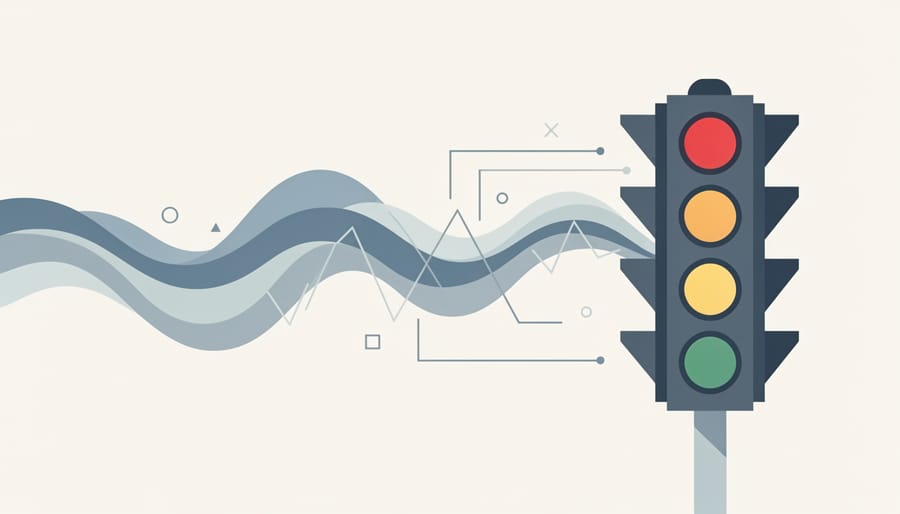
Like traffic signals that regulate flow, Protocol C4 uses timed interventions to manage pandemic waves strategically.
The Science Behind the Timing
Think of a forest fire spreading through dry woodland. Firefighters don’t just watch the flames grow—they monitor wind speed, humidity, and how quickly the fire doubles in size. When these factors cross certain thresholds, they escalate their response. Lockdown Protocol C4 works on remarkably similar principles, except instead of flames, we’re tracking an invisible pathogen.
The trigger point for C4 hinges on what epidemiologists call the reproduction rate, or R value. This number tells us how many people, on average, one infected person will pass the virus to. When R climbs above 1.3 in most models, the outbreak enters what I’d describe as a sprint phase—infections don’t just increase, they accelerate. Imagine a snowball rolling downhill, gathering mass exponentially. That’s when alternating lockdown approaches like C4 activate their strictest phase.
But R values don’t work alone. Hospital capacity serves as the second crucial metric. During the 2020 pandemic, I remember hearing from a friend working in emergency medicine who described their ICU situation using a parking lot analogy: “We’ve got 50 spaces, 47 are full, and cars are circling the block.” When healthcare systems approach 85-90% capacity for critical beds, the mathematics become brutal. Even a moderate increase in cases means people needing care won’t receive it.
The timing mechanism also accounts for transmission dynamics—how the virus actually moves through populations. Enclosed spaces, seasonal patterns, and population density all factor into sophisticated models. Scientists discovered that implementing restrictions just before exponential growth takes off proves far more effective than waiting until hospitals overflow. It’s like pumping the brakes before the cliff edge rather than at it.
The C4 protocol synthesizes these data streams, creating what amounts to an early warning system. When multiple indicators flash red simultaneously—rising R values, stressed hospitals, and favorable transmission conditions—the fourth-level response engages, buying precious time before the system collapses entirely.
How Cyclic Lockdowns Differ From What We’ve Tried Before
Think of a light switch. For most of 2020 and 2021, governments faced an impossible choice: leave the lights on and watch infection rates spiral, or flip them off and watch economies crumble. Protocol C4 proposed something different—a dimmer switch that adjusts based on what’s happening in real time.
Unlike the extended lockdowns that stretched for months in places like Melbourne or Wuhan, the cyclic lockdown pattern operates on shorter intervals, typically two to four weeks. The logic resembles how you might manage a chronic condition rather than treating an acute illness. You don’t take pain medication constantly; you take it when symptoms flare up.
Traditional continuous lockdowns suffered from what epidemiologists call “intervention fatigue.” When Melbourne imposed its 112-day lockdown in 2020, compliance started strong but deteriorated over time. People need hope, a finish line they can see. The cyclic approach offers that psychological relief valve—a promise that restrictions will ease soon, making adherence during the “on” periods more tolerable.
The economic reasoning follows similar logic. When businesses face indefinite closures, many simply collapse. Restaurants discard inventory, lay off staff permanently, and fold. But when closures follow a predictable rhythm, establishments can plan. They stock appropriately for open periods, maintain skeleton crews during closures, and survive to reopen. Data from Singapore’s early cyclic experiments in 2020 showed that businesses operating under predictable two-week cycles maintained 60% higher survival rates compared to those facing open-ended shutdowns.
The fully open approach, attempted in places like Sweden initially, presented its own problems. Without any brakes, hospitals reached capacity, elective surgeries stopped anyway, and fearful workers stayed home voluntarily, creating economic damage without the public health benefits of coordinated action.
Protocol C4 gained traction because it acknowledged an uncomfortable truth: this wasn’t a sprint but a marathon. Public health officials recognized that sustaining zero restrictions was unrealistic when case numbers climbed, but maintaining permanent lockdowns destroyed the social fabric and mental health they were trying to protect. The cycling strategy offered a middle path, matching intervention intensity to actual threat levels.
Research from the University of Toronto in 2021 demonstrated that cyclic approaches reduced overall restrictions by approximately 40% compared to continuous lockdowns while achieving similar infection control when properly timed. Citizens experienced more days of relative freedom, businesses maintained better cash flow, and crucially, compliance remained higher because people could endure short-term sacrifice when they knew relief was coming.
This wasn’t perfect, but it represented learning from earlier mistakes—an attempt to fight a long war sustainably rather than exhausting all resources in the first battle.
The Physics of Disease Transmission (And Why It Matters Here)
When I was learning to play piano as a kid, my teacher used to tell me that music follows patterns—predictable waves of rhythm and harmony. Disease transmission, it turns out, operates on surprisingly similar principles. Just as sound waves ripple through air following mathematical rules, infectious diseases spread through populations in patterns that physicists and epidemiologists can measure, predict, and model.
Think of a crowded concert hall. When someone coughs, respiratory droplets don’t just vanish—they travel outward following the physics of fluid dynamics, affected by air currents, humidity, and distance. Each infected person becomes like a pebble dropped in a pond, creating expanding circles of potential transmission. The mathematics governing these ripples mirror equations physicists use to describe everything from heat diffusion to the spread of forest fires.
This is where modeling becomes powerful. Epidemiological models, particularly the SIR model (Susceptible-Infected-Recovered), treat disease spread as a dynamic system with flows between different states. These models revealed something crucial for controlling COVID-19 spread: infections don’t grow linearly—they grow exponentially, like compound interest on a loan you never wanted.
But here’s the fascinating part. Just as waves can be dampened by changing the medium they travel through, disease transmission waves can be disrupted by altering social contact patterns. Protocol C4 leverages this physics-based understanding by creating what scientists call “temporal heterogeneity”—essentially, changing the landscape through which the disease travels by cycling between different restriction levels.
During lockdown phases, we’re effectively increasing the viscosity of the social medium, making it harder for the disease to propagate. During relaxation phases, transmission can resume, but crucially, not from the same baseline. Each cycle acts like a brake pedal, slowing momentum before it builds into an overwhelming wave.
The predictability of these patterns is what makes Protocol C4 viable. Unlike trying to predict individual human behavior—notoriously chaotic—population-level disease dynamics follow statistical patterns with remarkable consistency. Understanding these physics-like rules transforms pandemic response from guesswork into strategic intervention, making timing and rhythm as important as the restrictions themselves.
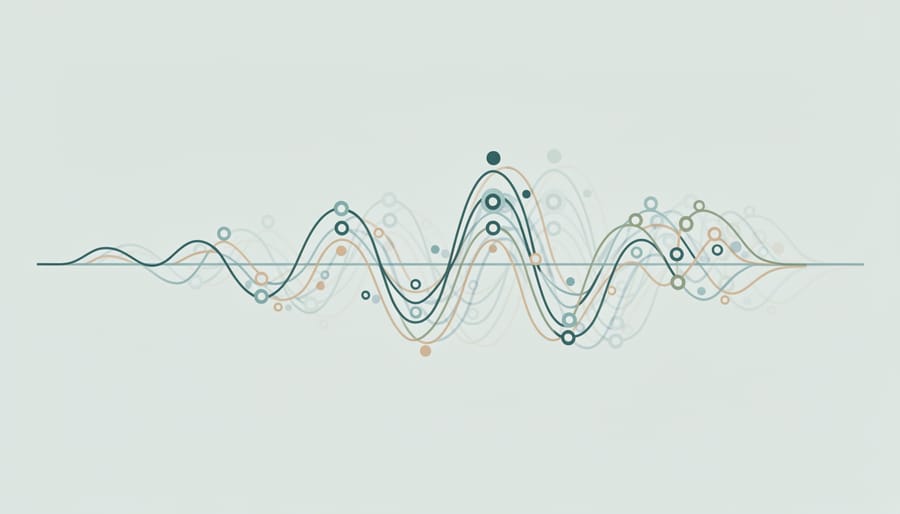
Disease transmission follows predictable wave patterns similar to physical phenomena observed in nature.
What Happens During a C4 Activation?
Imagine waking up to find your city has entered C4—what changes? Unlike the complete shutdowns many of us remember from 2020, a C4 activation operates more like a pressure valve, carefully calibrated to reduce disease transmission while keeping essential rhythms of society moving.
During C4, you’ll notice restrictions follow a “reduction, not elimination” philosophy. Schools typically shift to hybrid models, with younger children attending in-person on alternating days while older students move online. Think of it as creating breathing room in crowded spaces rather than emptying them entirely. My neighbor Sarah, a third-grade teacher, described it as “teaching to half a classroom on Monday, the other half on Wednesday, and everyone via screen on Friday.”
Workplaces remain open but with mandatory capacity limits—usually around 50 percent. This means staggered schedules become the norm. If you work in an office, you might find yourself at your desk Mondays and Thursdays while your colleague claims Tuesdays and Fridays. Remote work becomes strongly encouraged rather than optional for any role that permits it.
Retail and dining establishments stay operational but face tighter restrictions. Restaurants can serve indoor diners at reduced capacity, often requiring reservations where walk-ins once sufficed. Grocery stores implement one-way aisles again and manage entrance flows. These aren’t the anxiety-inducing scenes of panic-buying, though—supply chains continue functioning because warehouses and distribution never fully close.
Social gatherings face numerical limits, typically capping at 10-15 people for indoor events. You can still host your book club, but that 30-person birthday bash needs postponing or reimagining outdoors.
The duration varies, but C4 protocols typically run in predetermined cycles—often two to four weeks—after which epidemiological data determines whether restrictions ease or tighten. This predictability distinguishes C4 from earlier pandemic responses where uncertainty stretched indefinitely. People can plan around these cycles, arranging important activities during the “open” phases between lockdowns.
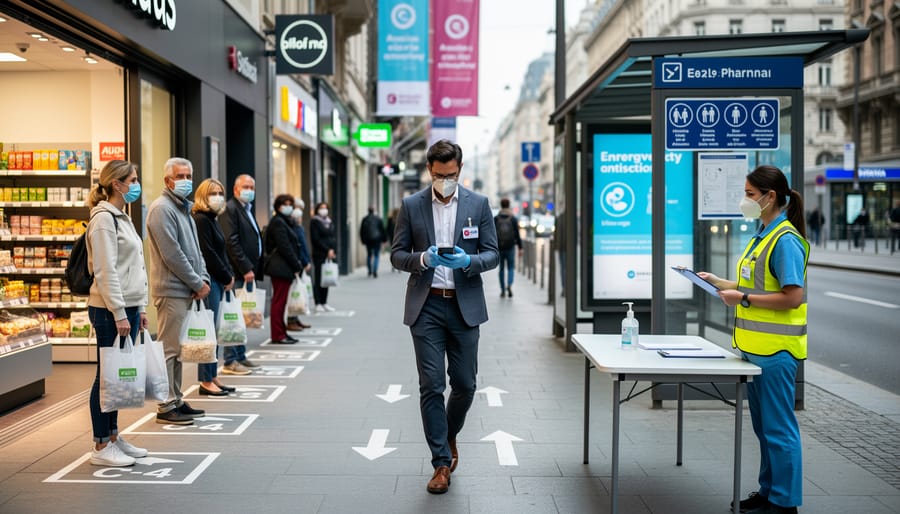
During C4 activation, daily routines adapt with specific measures while essential activities continue with modifications.
The Trade-Offs Nobody Talks About
Here’s the reality check nobody wants to hear: even the most elegantly designed public health strategy carries hidden costs, and cyclic lockdown approaches are no exception.
Think about it like repeatedly hitting the pause button on your life. The first time, you adjust. You understand the urgency. But by the third or fourth cycle? Many people describe it as living in limbo, never quite able to commit to plans or rebuild momentum. This compliance fatigue represents one of the most underestimated challenges of alternating restrictions. When people know another lockdown is coming, they may either rush to cram activities into open periods, potentially accelerating transmission, or simply stop following rules they perceive as endless.
The economic toll follows a similar pattern of compounding damage. A single lockdown allows businesses to potentially recover afterward. But cyclic approaches? Imagine a restaurant owner who must repeatedly hire staff, order inventory, then lay off workers and watch food spoil. Each cycle erodes financial reserves, making the next round harder to survive. Small businesses operate on thin margins, and this stop-start rhythm can prove more devastating than one longer closure followed by sustained reopening.
Mental health researchers have documented what they call “pandemic fatigue syndrome,” where the psychological burden of repeated restrictions accumulates rather than resets. The anticipatory anxiety of knowing another lockdown approaches, combined with grief over cancelled plans and social isolation, takes a measurable toll. For children and adolescents especially, these disruptions during critical developmental periods have consequences we’re only beginning to understand.
Then there’s the timing problem, which sounds straightforward but proves maddeningly complex in practice. Trigger restrictions too early, and you face public backlash over seemingly unnecessary measures. Wait too long, and case numbers explode beyond control. Add in data reporting delays, variable testing rates, and emerging variants, and you’re essentially flying blind with a two-week lag in your instruments.
None of this means cyclic approaches don’t work or shouldn’t be considered. But honest public health policy requires acknowledging these trade-offs rather than pretending they don’t exist. The communities that navigate these protocols most successfully tend to be those where leaders communicate transparently about both the benefits and the genuine hardships these strategies impose.
Standing at my kitchen window during the third wave, I watched my neighbor teaching her daughter to ride a bike in their driveway, masks dangling from the handlebars. It struck me then how pandemic management had become less about finding perfect solutions and more about discovering workable ones. Protocol C4 embodies this pragmatic evolution in our thinking.
What we’ve learned through cyclic lockdown strategies is surprisingly humble: we don’t always need sledgehammers when precision tools will do. Protocol C4 represents our growing sophistication in reading viral patterns, understanding human behavior, and honestly acknowledging what we can realistically ask of communities over extended periods. It’s not the definitive answer to pandemic management because, frankly, no single approach ever could be.
The real story here isn’t just about epidemiological models or transmission curves. It’s about how science adapts when confronted with messy reality. We started with blunt instruments during those early, frightening months, and gradually refined our methods as data accumulated and our understanding deepened. Protocol C4 sits within that trajectory of learning.
Perhaps most importantly, this approach reminds us that public health measures must account for the whole human experience. We need strategies that protect both our physical safety and our psychological wellbeing, our economic stability and our social connections. That balance remains delicate and imperfect, but acknowledging its necessity marks genuine progress. As we continue navigating this and future health challenges, that honest reckoning with complexity might be our most valuable tool.




Leave a Reply