At a UV index of 7, fair-skinned individuals can expect noticeable tanning in as little as 20 to 30 minutes, though this comes with significant sunburn risk that makes such exposure dangerous without protection. Medium skin types might safely tan in 40 to 60 minutes, while darker skin tones have more flexibility but still face DNA damage from prolonged exposure at this level.
Key Takeaway: UV index 7 is classified as “high” exposure, meaning unprotected skin can burn in 15 to 25 minutes for fair complexions. Tanning at this level requires strict time limits, frequent reapplication of SPF 30 or higher sunscreen, and awareness that any tan represents your skin’s damage response to ultraviolet radiation.
The challenge most people face is that UV index tells you intensity but not the full picture of how that radiation interacts with your specific skin. You’ve probably checked your weather app, seen that cheerful “7” displayed alongside the sunshine icon, and wondered whether an hour outside will give you a sun-kissed glow or send you home looking like a lobster. The answer depends on understanding what UV index actually measures compared to the irradiance values scientists use in labs, and why your skin type transforms those numbers into wildly different outcomes.
This isn’t just about vanity or beach planning. A UV index of 7 sits squarely in the range where casual sun exposure transitions from relatively safe to actively risky. The World Health Organization categorizes anything above 6 as requiring protective measures, yet millions of people treat a summer afternoon at this level as harmless tanning weather. What follows is a clear breakdown of how long you can realistically stay in UV 7 conditions, what that index number truly represents, and how to make informed decisions about sun exposure that balance your aesthetic goals with long-term skin health.
UV Index vs. Irradiance: A Quick Comparison
When you check your weather app for sun exposure guidance, you’re almost always seeing the UV Index, a number between 0 and 11+ that tells you how quickly you might burn. But behind that simplified scale lies a more precise measurement: solar irradiance, which scientists use to calculate exactly how much UV radiation reaches Earth’s surface. Both measure the same thing, ultraviolet radiation from the sun, but they serve different purposes and tell you different things about your tanning timeline.
The UV Index was created specifically for public use. It’s a standardized, easy-to-understand scale that factors in how different UV wavelengths affect human skin. When you see “UV Index 7,” you’re getting a number calibrated to biological risk, designed to help you make quick decisions about sun protection without needing a physics degree.
Irradiance, measured in watts per square meter, gives you the raw physical data. It’s what researchers use in laboratories and what feeds into UV Index calculations. Think of irradiance as the ingredient list and UV Index as the nutrition label, one is precise and technical, the other is processed for practical decision-making.
Measurement
What It Measures
Scale Range
Practical Use
UV Index
Biological risk from UV exposure
0 to 11+ (standardized)
Daily sun safety decisions, tanning time estimates
Irradiance
Physical energy of UV radiation
0 to ~15 W/m² (variable)
Scientific research, precise UV monitoring
For tanning purposes, UV Index matters more because it’s already weighted for how skin responds. A UV Index of 7 tells you that conditions are high-risk for burning, with fair skin potentially showing redness in 15 to 25 minutes. Irradiance measurements can vary by wavelength and don’t directly translate to skin damage without additional context about which UV-A and UV-B components are present.
Understanding the Two Measurement Systems
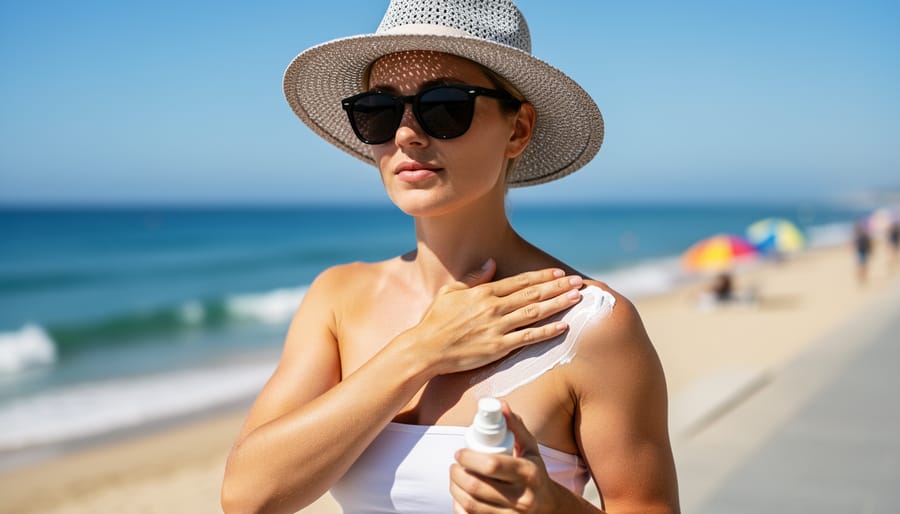
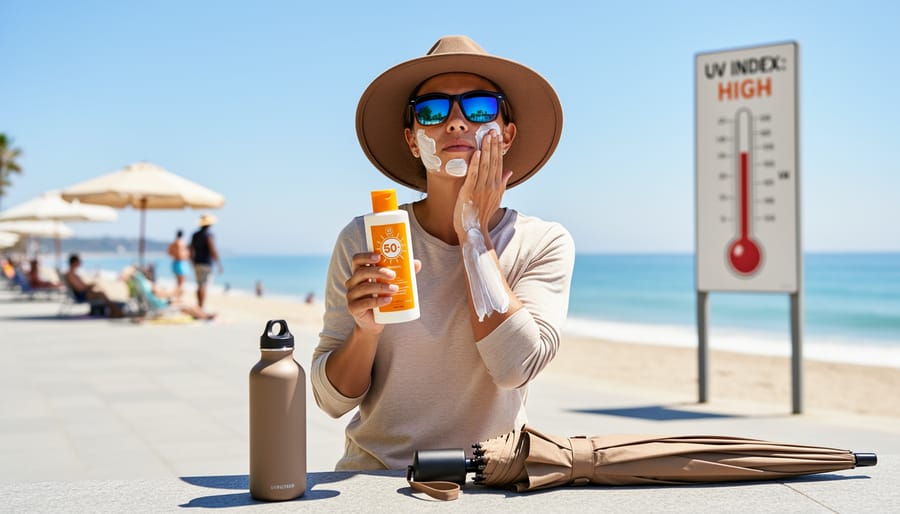
A person preparing for sun exposure shows practical sun-safety behavior when UV levels are elevated.
What UV Index Is and How It Works
The UV Index is essentially a translation service between complex atmospheric science and your daily sun safety decisions. Developed in the 1990s by Canadian scientists and later standardized by the World Health Organization, it condenses multiple wavelengths of ultraviolet radiation into a single number you can actually use.
Here’s what makes it work: UV radiation reaching Earth’s surface comes in two main forms, UVA and UVB. UVB causes most sunburns and has the strongest link to skin cancer, while UVA penetrates deeper and contributes to aging and melanoma. The UV Index weighs these wavelengths based on how much damage they cause to human DNA and skin cells, not just their raw intensity. A wavelength that’s particularly good at damaging genetic material gets counted more heavily in the final index number.
The resulting scale runs from 0 to 11+, where 0 means minimal risk (nighttime or heavy cloud cover) and anything above 11 represents extreme exposure conditions. Each whole number increase means roughly 25% more UV radiation reaching the ground. At UV Index 7, classified as “high” exposure, you’re dealing with enough intensity to burn fair skin in about 15-20 minutes without protection.
What you won’t find in the UV Index are precise measurements of energy or specific wavelength breakdowns. It deliberately strips away that complexity. Think of it like a weather app showing “feels like 85°F” instead of listing temperature, humidity, wind speed, and barometric pressure separately. You lose precision but gain immediate understanding of what the conditions mean for you.
What Irradiance Is and How It Works
Solar irradiance measures the actual power of ultraviolet radiation striking a surface, expressed in watts per square meter (W/m²). Unlike the simplified UV Index, which bundles everything into a 0-11+ scale for public consumption, irradiance gives you the raw physics: how much electromagnetic energy from the sun is hitting your skin at any given moment. Think of it as the difference between a thermometer showing temperature and a physicist measuring heat energy in joules.
Scientists and researchers prefer irradiance because it provides the granular data needed for precise studies. When dermatologists investigate how different wavelengths damage DNA or trigger melanin production, they need exact measurements, not a general safety rating. Irradiance captures the full spectrum of UV radiation, separating UVA (315-400 nm) from UVB (280-315 nm), which behave very differently in your skin despite both contributing to tanning and burning.
Irradiance
The measurement of electromagnetic power per unit area, typically expressed in watts per square meter (W/m²) for solar radiation. It quantifies the actual energy flux hitting a surface.
UVA
Longer ultraviolet wavelengths (315-400 nm) that penetrate deeper into skin, primarily responsible for immediate tanning and long-term aging effects.
UVB
Shorter ultraviolet wavelengths (280-315 nm) that cause most sunburns and directly damage DNA in skin cells, though they also trigger vitamin D production.
Watts per square meter
The standard unit for measuring irradiance, indicating how much solar power is delivered to one square meter of surface area.
Erythema
The medical term for skin reddening or sunburn, used as a biological endpoint when measuring UV exposure and calculating protective indices.
The relationship between irradiance and what you see in weather forecasts gets interesting. While UV Index predicts sunburn risk by weighting different wavelengths according to their biological effects, irradiance measurements remain wavelength-specific and unweighted. A reading of 0.25 W/m² in the UVB range tells a researcher exactly what’s happening at those burning wavelengths, whereas UV Index 7 is already an interpreted number designed for decision-making, not laboratory precision.
How They Measure Up: UV Index and Irradiance Side by Side
An atmospheric sky scene conveys how solar strength can feel harsher during higher UV conditions.
Precision vs. Practicality
Irradiance measurements give you raw data, the exact number of watts per square meter hitting your skin at a specific wavelength. Scientists use this precision to model DNA damage rates, compare conditions across studies, and calculate cumulative exposure down to the joule. But that level of detail creates a problem for everyday use: you’d need to know which wavelengths matter most, how to weight them for biological effect, and what threshold represents danger for your skin type. Most people don’t have that background.
UV Index solves this by doing the math for you. It weights different UV wavelengths according to how much they damage human skin, then converts the result into a simple 0-to-11+ scale. When you see “UV Index 7,” you immediately know you’re in the “high” category without needing to interpret 0.25 W/m² of UVB versus 5 W/m² of UVA. The trade-off is granularity, UV Index rounds and simplifies, potentially masking small but meaningful differences in exposure risk.
For tanning decisions, UV Index wins on usability. Irradiance wins when you need laboratory-grade accuracy.
Accessibility and Daily Use
UV Index wins hands-down for accessibility. Every major weather app, from your phone’s default to specialized forecasts, displays UV Index as a standard feature. Most show it alongside temperature and precipitation, making it effortless to check before heading outside. You’ll find hourly UV Index forecasts for virtually any location worldwide, often color-coded for quick interpretation.
Irradiance measurements, by contrast, remain largely invisible to casual users. Scientific weather stations track it, but consumer apps rarely display watts per square meter. Even when available, the raw numbers mean little without context, is 4.5 W/m² high or moderate? You’d need to cross-reference conversion charts or understand the physics behind the figures.
Real-time UV monitors designed for personal use typically report in UV Index units, not irradiance. These pocket-sized devices give you instant readings wherever you are, bypassing forecasts entirely. Some advanced models measure actual irradiance but convert it to UV Index for display, recognizing that most people can’t interpret energy flux values intuitively.
The practical takeaway: UV Index meets you where you are, while irradiance stays locked in research contexts.
Which Better Predicts Tanning and Burning
UV Index wins hands-down for predicting when your skin will tan or burn. It’s specifically calibrated to biological response, the Fitzpatrick skin type system and erythemal action spectrum are literally built into the calculation. When a forecast shows UV 7, it’s telling you that fair skin will start reddening in roughly 15-20 minutes, and this correlation holds remarkably well across different latitudes and seasons.
Irradiance measurements, by contrast, treat all UV wavelengths equally. A device measuring 50 W/m² doesn’t distinguish between UVB (which triggers both tanning and burning) and UVA (which penetrates deeper but causes less immediate redness). Two days with identical irradiance readings can produce different skin responses depending on the solar angle and atmospheric conditions that shift the UVB-to-UVA ratio.
The biological weighting matters enormously. Studies comparing forecast UV Index values to actual sunburn times show correlations above 0.85, meaning the index predicts real-world burning with impressive accuracy. Irradiance measurements require you to know the spectral distribution and then mentally convert watts per square meter into skin damage potential, a calculation most people can’t do.
For DNA damage specifically, both measurements correlate, but UV Index already factors in which wavelengths break DNA bonds most efficiently. When you’re deciding whether 30 minutes outside will trigger melanin production or chromosomal mutations, the index gives you the answer directly.
Tanning at UV Index 7: What to Expect
Different skin tones under the same sunlight highlights why UV exposure time and protection needs vary.
The Science Behind Tanning at This Intensity
When UV radiation at index 7 penetrates your skin, it triggers two distinct biological responses that we collectively call tanning. The first happens within minutes. UVA rays oxidize melanin already present in your skin cells, darkening it temporarily. This immediate pigment darkening fades within hours because you haven’t actually created new melanin, you’ve just chemically altered what was already there.
The real tanning process starts deeper. UVB radiation damages DNA in your skin cells, setting off an alarm system. Your body responds by activating melanocytes, specialized cells that manufacture melanin pigment. These cells ramp up production and distribute fresh melanin to surrounding skin cells like tiny umbrellas, absorbing future UV photons before they can cause more damage. This delayed tanning emerges 48 to 72 hours after exposure and can last weeks.
At UV index 7, you’re receiving roughly 175 milliwatts of erythemal UV radiation per square meter, enough to stimulate robust melanin production in most skin types. The intensity sits in a zone where tanning mechanisms activate reliably, but the margin between tanning and burning narrows considerably. Your skin cells are simultaneously repairing DNA damage, producing protective pigment, and thickening the outer layer as additional defense. This triple response defines what dermatologists call facultative pigmentation: your body’s attempt to prevent worse damage from happening next time.
Realistic Time Frames for Different Skin Types
At UV index 7, your skin type dramatically changes how quickly you’ll tan and when damage starts. People with very fair skin (Type I) who burn easily and rarely tan can experience reddening in as little as 10-15 minutes. Any pigment darkening takes days to appear, and burning typically happens before noticeable tanning occurs.
Fair skin that burns moderately (Type II) sees initial tanning around 20-30 minutes of exposure, though sunburn remains likely beyond this window. Light brown or olive skin (Type III) begins developing visible color within 30-45 minutes, with burning risk emerging after an hour of continuous exposure.
Medium brown skin (Type IV) starts tanning noticeably at 45-60 minutes, enjoying a wider safety margin before DNA damage accelerates. Dark brown skin (Type V) shows enhanced pigmentation after 60-90 minutes, while very dark skin (Type VI) may take 90 minutes or longer to darken visibly.
Here’s the critical distinction: tanning begins when melanocytes activate and start producing melanin, but cellular damage occurs from the first minute of UV exposure. That damage accumulates whether you see color change or not. The “safe tanning window” is largely a myth. Even exposures that produce the bronze you want are simultaneously damaging DNA in skin cells, setting the stage for premature aging and cancer risk down the line.
Who Should Use Which Measurement
For most people planning a day at the beach or deciding whether to wear sunscreen, the UV Index is your measurement. It’s designed for exactly this purpose: quick, actionable decisions about sun protection. You don’t need to understand watts per square meter or UVA versus UVB wavelengths. When your weather app says UV Index 7, you know immediately that you can burn in 15-25 minutes depending on your skin type, and you need protection.
Different situations call for different measurements:
– Casual beachgoers and weekend sun seekers: UV Index provides everything you need for safe tanning and burn prevention
– Outdoor workers (construction, landscaping, agriculture): UV Index for daily protection decisions, tracking exposure over shift hours
– Endurance athletes and hikers: UV Index for route planning and gear choices, especially at altitude where readings climb faster than expected
– Photographers and filmmakers: Irradiance measurements for lighting calculations and color temperature adjustments
– Dermatology patients on photosensitizing medications: UV Index for baseline caution, but consult your doctor for personalized thresholds
– Solar energy professionals: Irradiance for panel efficiency and power output predictions
– Researchers studying skin cancer or vitamin D synthesis: Irradiance for precise experimental control and reproducible conditions
If you’re monitoring specific wavelengths for medical reasons, scientific research, or technical applications, irradiance gives you the granular data you need. A researcher studying how UVB triggers vitamin D production needs exact nanometer measurements and intensity readings. A casual tanner doesn’t.
The practical test is simple: if you’re asking “how long until I burn” or “do I need sunscreen today,” you want UV Index. If you’re asking “what’s the exact UVB flux at 305 nanometers,” you need irradiance. Most sun safety questions fall firmly in the first category. Weather services worldwide report UV Index precisely because it translates complex radiation data into a number anyone can use. That’s not dumbing down the science. It’s making it accessible when lives and skin health depend on people actually using the information.
Common Questions About UV Measurements and Tanning
A wrist UV-monitoring device alongside outdoor beach materials represents checking UV conditions before deciding how long to stay in the sun.
Readers wondering about UV index 7 tanning often have questions beyond just time frames. The relationship between measurements, safety, and actual skin response creates confusion that deserves direct answers.
Can you actually tan safely at UV index 7?
Yes, but “safely” means limiting exposure to avoid burning while accepting that any tan involves some DNA damage. At UV 7, fair skin can start tanning in 10-15 minutes, but you should never exceed your skin type’s burn threshold (typically 15-30 minutes for fair skin, longer for darker tones).
Does cloud cover change the UV index reading?
Clouds reduce UV radiation reaching the ground, but UV index forecasts already account for predicted cloud cover. Thin clouds might only block 10-20% of UV rays, while thick overcast can cut intensity by 50% or more, effectively lowering the actual UV index below the forecast.
How accurate are UV predictions from weather apps?
Most apps pull from national weather services and are reasonably accurate for clear-sky predictions (within one index point), but they struggle with rapidly changing conditions. Real-time measurements from personal UV monitors give more precise readings if you need exact data.
Is there such a thing as a safe UV level for tanning?
Not really. Any UV exposure that triggers melanin production has already caused some cellular damage; the tan itself is your skin’s damage response. Lower UV indices just extend the time before burning occurs, giving you a wider window to control exposure.
The vitamin D question deserves separate attention. You can synthesize adequate vitamin D at UV index 7 in just 5-10 minutes of midday sun on arms and legs, far less time than it takes to develop a visible tan. Chasing a tan for health reasons doesn’t hold up since you’d get the vitamin D benefit long before the cosmetic change appears, and the extra exposure only adds risk without nutritional gain.
Another common confusion involves measurement timing. UV index peaks around solar noon (when the sun reaches its highest point, not necessarily 12:00 on your clock), so a UV 7 forecast represents the maximum expected value for that day. Morning and late afternoon readings will be lower, meaning your actual tanning time would need adjustment based on when you’re outside. Apps showing hourly UV predictions help you plan around these fluctuations rather than assuming the day’s peak value applies at all hours.
What Each Option Is
UV Index is a numerical scale that translates complex ultraviolet radiation measurements into a single, easy-to-understand number. It runs from 0 to 11 and beyond, with higher numbers indicating greater risk of harm from unprotected sun exposure. Weather services and apps report it daily because it accounts for sun angle, altitude, cloud cover, and ozone levels, all the factors that affect how much UV radiation reaches your skin. The World Health Organization standardized it in the 1990s specifically so anyone could check a forecast and know whether they need sunscreen.
Irradiance measures the actual power of UV radiation hitting a surface, expressed in watts per square meter (W/m²). Scientists use it in research because it provides precise, quantifiable data about electromagnetic energy. Unlike the UV Index, irradiance doesn’t translate radiation into risk categories. It’s a raw physical measurement, similar to how a thermometer reports temperature without telling you whether to wear a jacket. Researchers need this precision when studying atmospheric physics, solar energy, or biological responses to specific wavelengths, but most people never encounter irradiance values in daily life.
Who Should Choose Which
For everyday sun safety and tanning decisions, stick with UV Index. It’s designed specifically for non-scientists who need quick, actionable guidance about when to apply sunscreen, how long to stay out, and what precautions to take. Weather apps and forecasts report it universally, and the 0-11+ scale translates directly into risk categories anyone can follow. If you’re planning beach time, outdoor workouts, or gradual tanning sessions, UV Index gives you everything you need without requiring specialized equipment or scientific background.
Choose irradiance measurements only if you’re conducting research, calibrating UV equipment, or need precise data for phototherapy applications. Dermatology clinics, agricultural researchers studying crop UV exposure, and scientists measuring vitamin D synthesis rates rely on irradiance because their work demands exact wavelength-specific readings. Unless you’re operating in a professional scientific context where precision matters more than convenience, the added complexity of irradiance measurements offers no practical advantage for personal sun exposure decisions.
The UV Index already incorporates the relevant irradiance data and translates it into language designed for your safety. Trust the simpler tool built for your needs.
Understanding both UV Index and irradiance gives you a complete picture of sun exposure, but for tanning decisions, the UV Index wins on practicality every time. It’s readily available, accounts for biological skin response, and translates complex radiation measurements into actionable guidance you can actually use.
At UV index 7, you’re working with moderate-to-high intensity sunshine. Fair skin types should limit initial exposure to 10-15 minutes, while darker skin can safely extend that window to 30-45 minutes. These aren’t arbitrary numbers, they reflect the balance between stimulating melanin production and triggering DNA damage that leads to sunburn and long-term skin harm.
The real takeaway here isn’t choosing between measurement systems. It’s recognizing that both tell you the same essential truth: UV radiation is powerful stuff that demands respect. Check the UV Index before heading outside, know your skin type’s limits, and remember that a gradual tan built over multiple sessions always beats a single long exposure. The sun will be there tomorrow, but damaged skin cells accumulate consequences you’ll carry for years.
Smart sun exposure starts with understanding what the numbers actually mean, then acting on that knowledge consistently.




Leave a Reply