Request climate risk reports from your local planning authority before listing the property—these documents reveal flood zones, coastal erosion projections, and wildfire susceptibility that buyers will investigate anyway. When you sell your inherited house fast, understanding these disclosures protects you legally and prevents deal collapse at the eleventh hour.
Examine your inherited property’s insurance history for claim patterns related to weather events, as these records often tell the climate story before official assessments do. Contact the previous insurer to understand whether premiums increased due to environmental factors—information that becomes part of your disclosure obligations in many jurisdictions.
Commission an independent property survey specifically addressing climate vulnerabilities if the home sits in a transitional risk zone where regulations remain unclear. This proactive step demonstrates good faith to buyers while clarifying your legal position.
Here’s what most executors miss: climate disclosure isn’t just about ticking legal boxes. It’s about the collision between family memory and planetary reality. That coastal cottage where you spent childhood summers now sits in a redefined flood zone. The mountain cabin your grandparents built faces wildfire risk categories that didn’t exist when they laid the foundation. These aren’t abstract environmental talking points—they’re concrete factors reshaping property transactions.
The science behind these assessments draws from decades of meteorological data, satellite imaging, and predictive modeling that governments increasingly mandate sellers acknowledge. You’re not expected to become a climate scientist, but understanding the basics—how hundred-year flood plains get recalculated, why insurers use different risk models than they did five years ago—transforms overwhelming disclosure requirements into manageable steps. This knowledge gap between what regulators expect and what grieving families understand creates the real challenge in inherited property sales today.
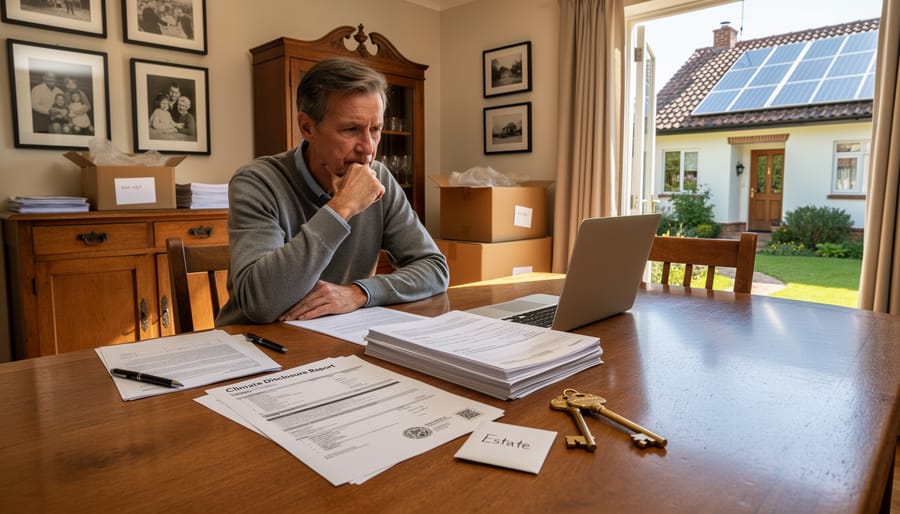
Inheriting property comes with both emotional memories and complex legal responsibilities, including new climate disclosure requirements.
What Climate Risk Disclosure Actually Means for Your Property
The Science Behind the Disclosure
Climate scientists assess property-level risks much like meteorologists predict tomorrow’s weather, except they’re looking decades into the future and focusing on your specific street corner. The process begins with historical data—think of it as studying a patient’s medical history before diagnosing current symptoms. Scientists examine decades of flood records, wildfire patterns, temperature extremes, and storm surges for your region.
Here’s where it gets fascinating: researchers layer this historical information with physics-based computer models that simulate how our changing atmosphere affects local conditions. These aren’t crystal balls, but rather sophisticated calculations based on fundamental principles like how warmer air holds more moisture (leading to heavier rainfall) or how rising sea levels combine with storm surges during hurricanes.
For your grandmother’s coastal cottage or your uncle’s mountain retreat, scientists consider elevation, proximity to water bodies, vegetation patterns, and even soil composition. They use satellite imagery, ground sensors, and topographical maps to build detailed risk profiles. The climate risk assessment combines multiple future scenarios—imagine different possible paths our climate might take based on global emissions—to estimate probabilities rather than certainties.
What makes this relevant to your inherited property sale is that these scientific assessments increasingly translate into real-world impacts: insurance costs, buyer concerns, and disclosure requirements. Understanding the science helps you grasp why buyers are asking these questions and prepares you to discuss risks honestly and knowledgeably.
When Grandma’s House Sits in a New Risk Zone
Margaret’s childhood home sat three blocks from the Pacific coast in Northern California for sixty years without incident. Her grandmother bought it in 1963, raised three children there, and always joked about having “the best ocean views without the beachfront insurance rates.” When Margaret inherited the property last year, she discovered those three blocks no longer offered the buffer they once did.
The home now sits in a newly designated flood risk zone—not because the house moved, but because the risk did. Changing weather patterns have intensified coastal storms, and rising sea levels mean king tides now reach areas that stayed dry for generations. The cheerful yellow cottage that survived decades of storms suddenly required disclosure statements Margaret had never heard of.
Similarly, Tom’s uncle’s mountain retreat in Colorado seemed immune to wildfire risk when purchased in 1985. Surrounded by lush forest, it represented the ultimate escape from city life. But decades of drought and warmer winters transformed that protective forest into potential fuel. Properties that once advertised their wooded seclusion now carried wildfire risk classifications that made buyers hesitate.
These aren’t stories of reckless building in obviously dangerous locations. They’re examples of how climate’s shifting baseline has redrawn risk maps across landscapes that felt permanently safe. The house hasn’t changed, but the world around it has.
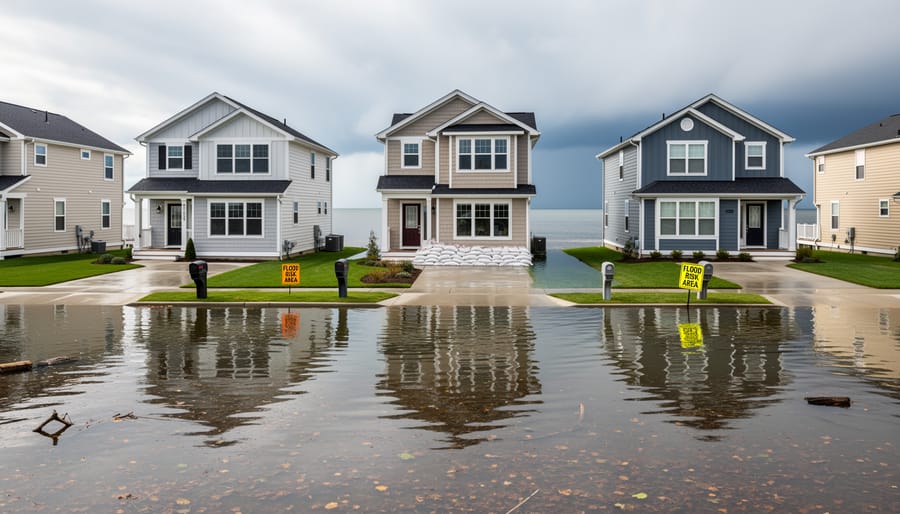
Properties once considered safe from flooding now face increased climate risks due to changing weather patterns and sea-level projections.
The Legal Landscape: What You Must Disclose (and What You Should)
State-by-State Variations
Navigating climate disclosure requirements across the United States feels a bit like playing a board game where the rules change depending on which square you land on. Each state writes its own playbook, and the differences can be dramatic.
California leads the pack with some of the most comprehensive requirements. Sellers must disclose whether a property sits in a wildfire hazard zone, and recent legislation pushes for broader climate risk transparency. If your inherited home overlooks the Pacific in Malibu, expect questions about coastal erosion and fire risk. New York follows suit, particularly in vulnerable coastal areas where Hurricane Sandy’s memory still shapes real estate conversations. Sellers there face increasing pressure to reveal flood history and future vulnerability.
Meanwhile, states like Florida present a puzzling contradiction. Despite facing perhaps the nation’s most acute climate challenges from hurricanes, sea level rise, and flooding, disclosure requirements remain surprisingly minimal. It’s like standing in a rainstorm while insisting your umbrella is optional.
Connecticut, Rhode Island, and Oregon have implemented moderate disclosure frameworks, recognizing climate risks without yet matching California’s thoroughness. Many interior states maintain traditional disclosure standards focused on structural issues, treating climate as tomorrow’s problem rather than today’s reality.
Before listing your inherited property, spend an afternoon researching your specific state and county requirements. Call the local assessor’s office, consult a real estate attorney familiar with your jurisdiction, and review recent legislative changes. What’s optional in one zip code might be legally mandatory twenty miles away. This homework protects you legally while helping potential buyers make informed decisions about their future home.
The Inherited Property Complication
Inheriting a home means inheriting its history, but you’re walking into a story whose chapters you never read. When your aunt lived through that 2018 flood, she knew the water reached the back porch. You’re discovering it from a box of old insurance papers. This knowledge gap creates a genuine complication: what are you legally expected to disclose about climate risks when you weren’t there to experience them?
The legal standard typically distinguishes between what you should reasonably know versus what only long-term occupants might know. You’re generally required to disclose what you discover through reasonable investigation, like reviewing property records, insurance claims, or observable conditions. That persistent water stain in the basement becomes your responsibility once you’ve seen it, even if you don’t know its full story.
Think of it like inheriting a car with an unknown service history. You can’t speak to how the previous owner maintained it, but you can examine its current condition and review available records. Similarly, you’ll want to request disclosure forms the previous owner completed, review past insurance claims, and conduct standard inspections. What matters isn’t matching your predecessor’s intimate knowledge, but demonstrating you made honest efforts to understand and share what you found.
How Climate Risks Actually Affect Your Sale
The Insurance Crisis You Need to Know About
Here’s what my aunt discovered when she tried to sell her beach cottage last year: the insurance company had quietly declined to renew the policy. No dramatic cancellation letter, no explanation—just a polite notification that they wouldn’t be continuing coverage. Suddenly, a charming family retreat became nearly unsellable.
This scenario is playing out across North America with startling frequency. Insurance companies, unlike politicians or even scientists, can’t afford to debate climate projections. Their entire business model depends on accurately pricing future risk. When insurers see flood maps, wildfire models, and hurricane trajectories, they’re looking at their bottom line. And increasingly, that bottom line is telling them to pull out of high-risk areas entirely.
The insurance industry’s response creates a cascade effect you need to understand. A property without insurance is essentially unbuyable for most people—mortgage lenders won’t finance it. Even if you find a cash buyer, the absence of affordable insurance dramatically reduces what they’ll pay. It’s like trying to sell a car that nobody can legally drive.
This connection between atmospheric conditions and market value isn’t theoretical anymore. Properties in California’s wildfire zones, Florida’s coastal communities, and Louisiana’s flood-prone parishes are experiencing this firsthand. The science of climate risk has become the reality of property value, with insurance companies serving as the unwilling translators.
Finding and Understanding Climate Risk Data for Your Property
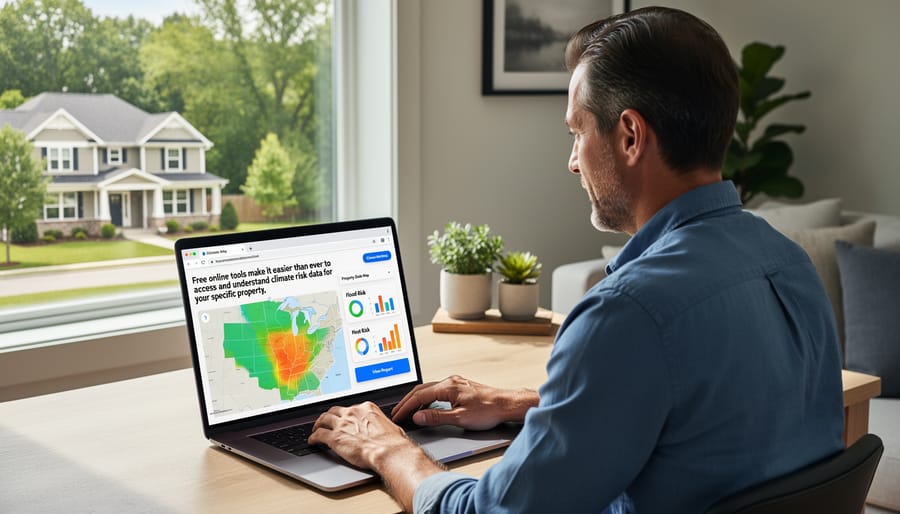
Free online tools make it easier than ever to access and understand climate risk data for your specific property.
Free Tools That Actually Work
When my aunt handed me the keys to my uncle’s coastal cottage last year, I had no idea I’d spend the following weeks becoming an amateur climate scientist. But that’s exactly what happened when a potential buyer asked about flood risk—and I realized I had absolutely no idea how to answer.
The good news? You don’t need to hire expensive consultants to get started. Several free tools can give you a solid preliminary assessment, though each comes with important caveats.
FEMA’s Flood Map Service Center is probably your first stop. It’s clunky and looks like it hasn’t been updated since 2005, but it’s the official source for flood zone designations that directly affect insurance and property values. The main limitation: it’s backward-looking, based on historical data rather than future projections under changing climate conditions.
Climate Check, developed by the First Street Foundation, offers a more forward-thinking view. Simply enter an address and you’ll get letter grades for flood, fire, and heat risk over the next 30 years. I found it remarkably user-friendly—like a report card for your property’s climate future. The catch is that it simplifies complex science into grades, which means you’re missing nuance that sophisticated buyers might dig into.
Risk Factor, also from First Street, provides similar information with slightly more detail about specific hazards. Both tools are excellent starting points, though they work best when used together with local planning department resources that understand your property’s unique microclimate and topography.
Think of these tools as your initial reconnaissance mission—valuable, free, and imperfect.
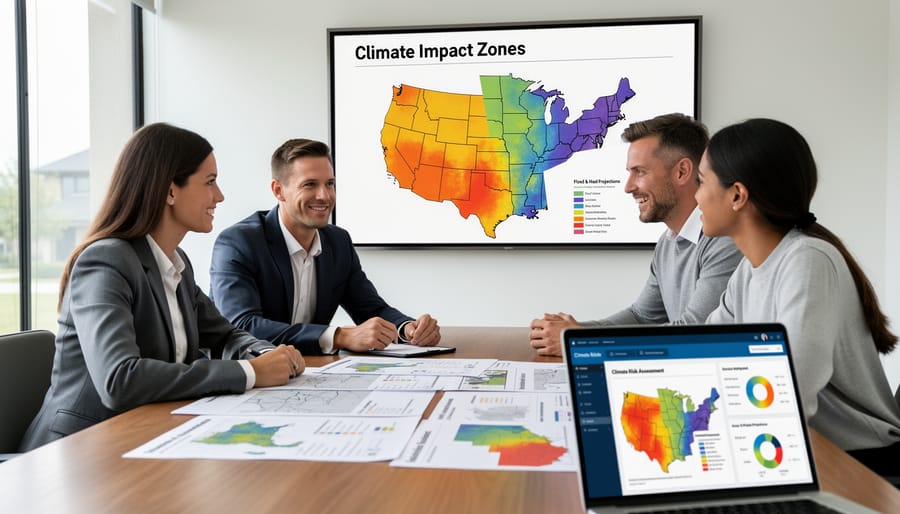
Transparent communication about climate risks can build buyer trust and lead to smoother property transactions.
Turning Transparency Into Trust (and Maybe a Better Sale)
Here’s what most sellers don’t realize: buyers are already Googling your property’s flood zone status before they even schedule a showing. They’re checking fire maps, sea level rise projections, and insurance availability. The question isn’t whether climate risks will come up—it’s whether you’ll control the narrative when they do.
My aunt learned this the hard way when selling my grandmother’s coastal cottage. She avoided mentioning the updated flood maps, hoping buyers wouldn’t notice. They noticed. Every single one pulled out after their due diligence, and each withdrawal made the next buyer more suspicious. When she finally switched strategies and led with transparency—providing a folder with current flood zone data, elevation certificates, and mitigation options the property already had—the home sold within three weeks.
Disclosure doesn’t mean handing buyers a list of reasons to walk away. Think of it like disclosing that a house has original 1960s plumbing. Yes, it’s information a buyer needs, but you’re also showing you’re trustworthy and that you’ve done your homework. You can acknowledge that the property sits in a moderate wildfire risk zone while also pointing out the defensible space already cleared, the fire-resistant roofing installed two years ago, or the neighborhood’s excellent firefighting response times.
The same climate data that reveals risks can also highlight opportunities. Properties with higher elevation, good drainage, or climate-resilient features become more valuable as buyers grow more climate-conscious. Leading with this information positions you as the knowledgeable, honest seller—exactly the person buyers want to work with when making one of life’s biggest purchases.
When you present climate information proactively, you’re not just following the law. You’re demonstrating that this property has been thoughtfully evaluated, reducing the buyer’s anxiety and shortening their decision timeline. Trust, it turns out, moves houses faster than silence ever could.
Selling an inherited home brings enough emotional complexity without adding climate risk assessments to the mix. Yet here we are, standing at the intersection of personal loss and planetary change, holding documents that quantify flood zones and wildfire exposure alongside estate paperwork. It’s a lot to process, and there’s no shame in finding it overwhelming.
Think of climate disclosure requirements not as bureaucratic obstacles, but as part of a broader cultural shift—similar to how we gradually accepted that smoking causes cancer or that seatbelts save lives. Society doesn’t change its understanding overnight. We’re collectively learning to see our homes and neighborhoods through a new lens, one that acknowledges the ground beneath our feet is changing in measurable ways.
Your grandmother’s house might sit in what was once considered a safe distance from the creek. The numbers have shifted, not because anyone got it wrong before, but because we’re living in different conditions now. Understanding this doesn’t make you an alarmist or a pessimist—it makes you informed, which is exactly what science asks of us.
The practical work of gathering disclosures, consulting with agents, and presenting information to buyers serves a purpose beyond legal compliance. You’re participating in the essential human practice of sharing knowledge, helping someone else make decisions with open eyes. That’s fundamentally what science communication is: taking what we’ve learned and passing it forward.
This process may feel like one more burden during an already difficult transition. But knowledge, even uncomfortable knowledge, gives us agency. It lets you walk into conversations prepared, advocate for fair pricing, and ultimately move forward with clarity. That’s worth something in an uncertain world.



Leave a Reply