


Written by john on August 15, 2021
How Luminous Is the Sun?
Planet EarthMore often than not, people randomly blurt out questions like “how bright is the sun” or “how many lumens is the sun” out of sheer curiosity.
However, for a fair amount of people, this is another way to ask, “how much light does a lumen represent?” For the longest time, we have been introduced to various specifications for lamps, flashlights, indoor lighting, LED lights, and the like.
In fact, the list is growing longer and longer as time passes by. Of course, we tend to compare these with the sun at some point, and none of these could ever compare. So to clear up things, here are the definitive answers to these questions.
How Much Visible Light Does the Sun Produce?
To start, a lumen is a quantifier for visible light. So the number of lumens a source of light has will determine the amount of visible light it produces.
The sun produces various types of electromagnetic energy that complete the spectrum: radio, microwave, infrared, visible, ultraviolet, x-ray, gamma, and cosmic rays. The number of lumens, however, is only limited to the band of visible light. This is different from the moon.
Its wavelength determines the size of a wave. In turn, the amount of energy in a light wave is indirectly proportional to its wavelength. In simpler terms, the shorter the wavelengths, the greater the energy. Moreover, sunlight is also rich in ultraviolet rays that damage the eye. As explained here:
After thorough studies, scientists and engineers have standardized the average value for spectral irradiance of Earth or the “Solar Constant” at 1366.1 watts per square meter. This determines the sun’s brightness from the distance of the Earth’s orbit.
Now, this is only for the sun’s full spectrum. So, to determine the visible light, we would need to narrow it down to the light that the eye can detect. For stars with a temperature of 5778 K, including the sun, the result is 93, which means that every watt produced by the sun is equivalent to 93 lumens of visible light.
By considering this, for every square meter from the Earth’s orbit, the sun releases 127,000 lumens. This explains why it can be excruciating to stare a few seconds too long at the sun.
Now, let’s find out the sphere’s area with a radius that corresponds to the distance from the Earth to the sun.
Simply put, the area has a total of 281.2 sextillion square meters, multiplied by the 127,000 lumens per square meter, the total number of lumens produced by the sun is 35.73 octillion lumens.
How Many Lumens from the Sun Hit the Earth?
The majority of the light produced by the sun does not hit the Earth. To determine how many lumens of the sun hit the Earth, you need to take the surface area ratios of a circle and a 1 AU radius sphere together with the Earth’s radius.
This will result in two quantities: 127.8 trillion square meters and 281.2 sextillion square meters. This implies that, apart from the 16.24 quintillion lumens of light that hit the Earth, there is also 2.2 billion times more light that does not hit the Earth’s surface.
What’s even more mind-blowing is that this statistic implies that the amount of sunlight that hits the Earth greatly overpowers its total consumption, which is why solar power has immense potential.
Now, if we compare this to artificial light sources, then as expected, the sun immensely overpowers all of these. For instance, the regular diffuse skylight is at 120 lumens per watt; low-pressure sodium lamps are 200 lumens per watt.
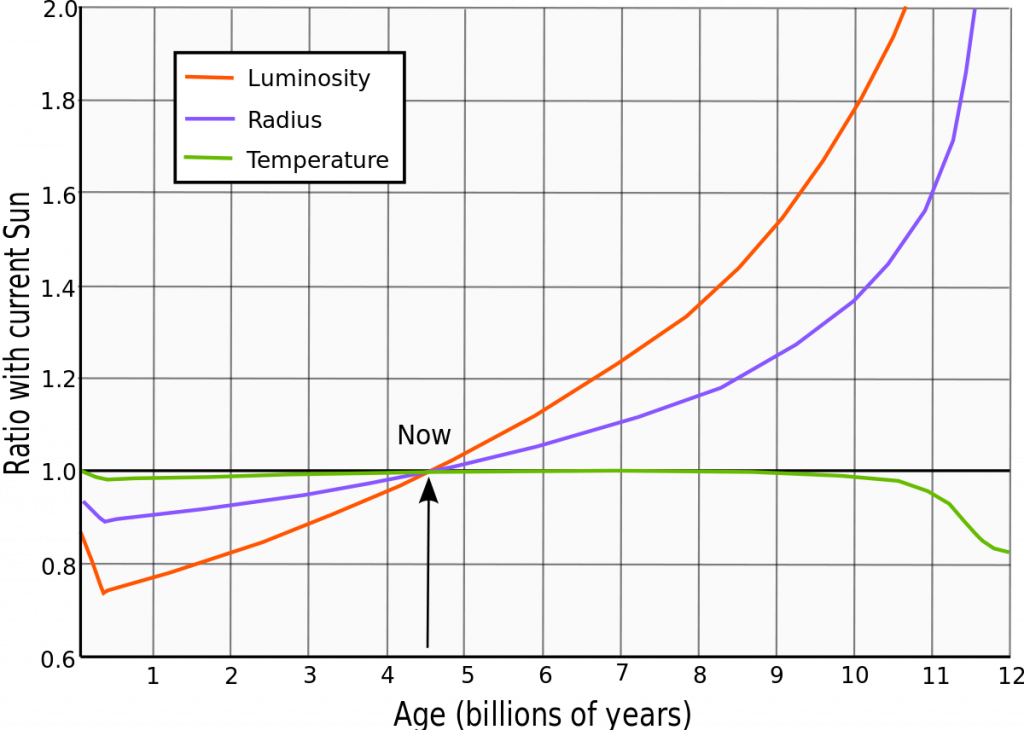
In contrast, the highest for bright white LED lights is at around 300 lumens per watt, which is also considered the theoretical limit. However, all of these still cannot match natural light’s spectrum as expected. Even during a cloudy day, the sun’s light production only drops to about 1000 lumens per watt.
However, if you think about it, there would be no reason to try to match the sun’s light production, even if possible. Even 60 lumens of light is enough to blind a person if it is flashed in a dark environment.
Conclusion
Overall, being aware of the sun’s luminosity helps manufacturers have a baseline for their products. Moreover, by constantly identifying specific factors that need to be considered in producing different light-producing products, it becomes easier for them to determine how many lumens are required to light an area well.

Leave a Reply