Imagine walking into a bank for a business loan, only to have your application rejected—not because of your credit score, but because artificial intelligence determined your coastal warehouse faces unacceptable flooding risks in fifteen years. This scenario isn’t science fiction. Financial institutions are increasingly deploying AI systems that analyze climate data, satellite imagery, and predictive models to evaluate whether properties, businesses, and entire communities represent sound investments in our rapidly changing world. Platforms like RadCred are leading this transformation.
These platforms merge traditional credit assessment with climate risk analysis, fundamentally transforming how lenders decide who gets funding and at what cost. These algorithms digest massive datasets—hurricane trajectories, rising sea levels, wildfire patterns, drought projections—then calculate whether your dream home or expanding factory sits in tomorrow’s danger zone. For borrowers, this means climate change has become as important to loan approval as income verification.
The stakes extend far beyond individual disappointment. When AI flags entire zip codes as high-risk, investment flows away from vulnerable communities, potentially accelerating economic decline in areas that might desperately need capital to adapt. Conversely, these same tools could direct resources toward climate-resilient infrastructure and sustainable development, rewarding forward-thinking businesses while penalizing environmental laggards.
Understanding how these AI systems work—what data they analyze, how they weight different risks, and where human oversight fits—has become essential for anyone seeking financing in the climate era. The algorithms assessing your loan application today aren’t just reading your bank statements; they’re reading the planet’s future, and deciding whether you’re part of it.
When Your Perfect Loan Application Meets an Imperfect Planet
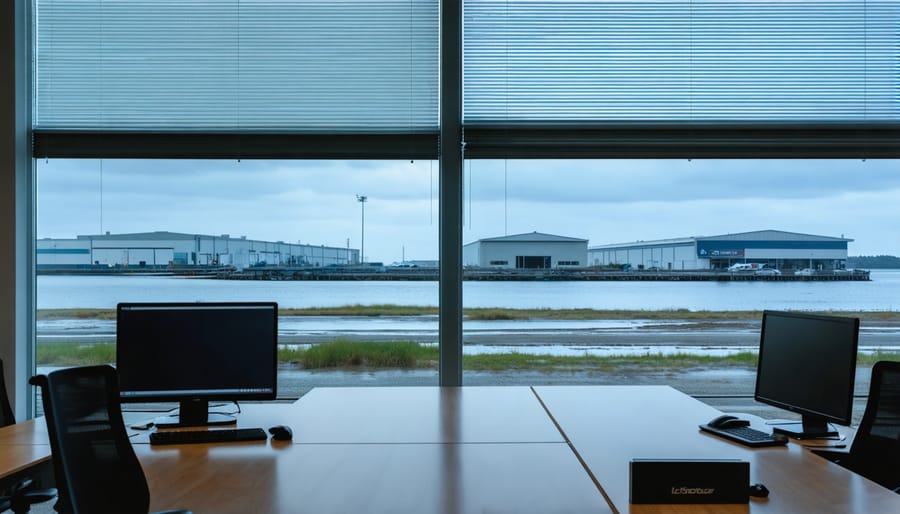
Coastal properties face increasing scrutiny from AI-powered lending systems that assess climate risks including sea level rise and storm surge.
The Old Way: Credit Scores and Income Ratios
For decades, getting a loan worked like a snapshot of your financial life at a single moment in time. Picture a bank officer examining your application through a narrow lens—they’d scrutinize your credit score (that three-digit number following you around like a shadow), calculate your debt-to-income ratio, and verify your employment history. It was straightforward, almost mechanical: if your numbers added up, you got the green light.
This system made sense in a relatively stable world. A steady job at a manufacturing plant, a credit score above 700, and monthly debts under 36% of your income? Congratulations, here’s your mortgage. But here’s what this approach couldn’t see: whether your dream home sits in a floodplain that’ll be underwater in fifteen years, or if the factory employing half your town depends on an industry facing climate-driven disruption. Traditional lending looked backward at your financial history while remaining blind to environmental risks looming on the horizon—risks that could devastate both your investment and the bank’s. It was like driving forward while only checking the rearview mirror.
The New Reality: Your Property’s Climate Report Card
Remember when buying a house meant worrying about your credit score and little else? Those days are fading fast. Today, lenders are pulling up something entirely new alongside your financial history: your property’s climate report card.
Think of it this way: your credit score tells lenders if you’re likely to repay a loan. But what good is a stellar credit score if the home securing that loan sits in a flood zone that’s underwater—literally—every five years? It’s like lending money for a car that’s missing an engine. The numbers might look great on paper, but the underlying asset is fundamentally compromised.
This is where climate data enters the picture, and it’s become surprisingly sophisticated. Modern climate risk assessments examine dozens of factors: historical flood patterns, wildfire proximity, hurricane exposure, even how rising sea levels might affect a property thirty years from now. Insurance companies have been quietly using this information for years, raising premiums or pulling out of high-risk areas entirely. Now lenders are catching on.
What makes this shift fascinating is how quickly it’s happened. Just five years ago, most banks barely glanced at climate considerations. Today, some won’t approve mortgages in certain areas without additional safeguards. Your property’s location—once simply about neighborhood and commute times—now carries an environmental price tag that directly affects your borrowing power.
The Physics Behind the Predictions
Reading the Planet’s Vital Signs
Picture a doctor examining a patient—checking temperature, blood pressure, heart rate—to assess overall health. AI climate risk systems work remarkably similarly, except their patient is our entire planet. These sophisticated algorithms function like tireless physicians, continuously monitoring Earth’s vital signs through an intricate network of data sources.
Every day, satellites orbiting overhead capture terabytes of information: sea surface temperatures, ice sheet movements, vegetation patterns, and atmospheric conditions. Weather stations scattered across continents provide ground-level measurements, while ocean buoys track currents and temperatures. Climate models—complex simulations based on decades of scientific research—project future scenarios. Think of it as assembling a massive jigsaw puzzle where each piece reveals something crucial about climate patterns.
The AI doesn’t just collect this data; it spots patterns humans might miss. Much like how your phone’s facial recognition learns to identify you from countless angles, these systems learn to recognize the fingerprints of climate risk. They detect when coastal erosion accelerates near a beachfront property or identify drought patterns threatening agricultural regions. They even integrate data from geological surveys to understand long-term land stability.
What makes this revolutionary is the speed and scale. Where traditional risk assessment might take weeks and examine limited data points, AI processes millions of variables in minutes, creating comprehensive risk profiles that were previously impossible to generate.
AI systems analyze data from satellites and weather stations worldwide to predict climate risks decades into the future.
From Data to Dollars: Making Climate Predictions Bankable
Think of climate data like a foreign language that banks can’t quite read. Scientists speak fluently about atmospheric carbon concentrations and sea-level projections, while lenders need answers in their native tongue: default probabilities, asset depreciation rates, and portfolio exposure percentages.
This is where machine learning becomes the translator. These AI systems digest decades of climate research—everything from how climate models predict intensifying storms to shifting precipitation patterns—and convert those forecasts into numbers that make sense on a balance sheet. It’s like taking a weather forecast and transforming it into advice about whether to pack an umbrella or cancel your picnic entirely.
The process involves training algorithms on historical data: past floods and their insurance claims, drought patterns and agricultural loan defaults, wildfire seasons and property value drops. The AI identifies patterns invisible to human analysts—perhaps coastal properties within certain elevation ranges depreciate faster when hurricane frequency increases, or specific crop types show vulnerability thresholds at particular temperature rises.
What emerges isn’t just a single risk score but a nuanced financial portrait. Instead of treating all waterfront properties identically, the system might flag a Miami beachfront condo differently than a Seattle harbor warehouse, accounting for local climate trajectories, infrastructure resilience, and regional adaptation investments. The result? Scientific predictions become actionable financial intelligence that lenders can actually use to make smarter decisions.
Real Stories: Where Climate Risk Changed Everything
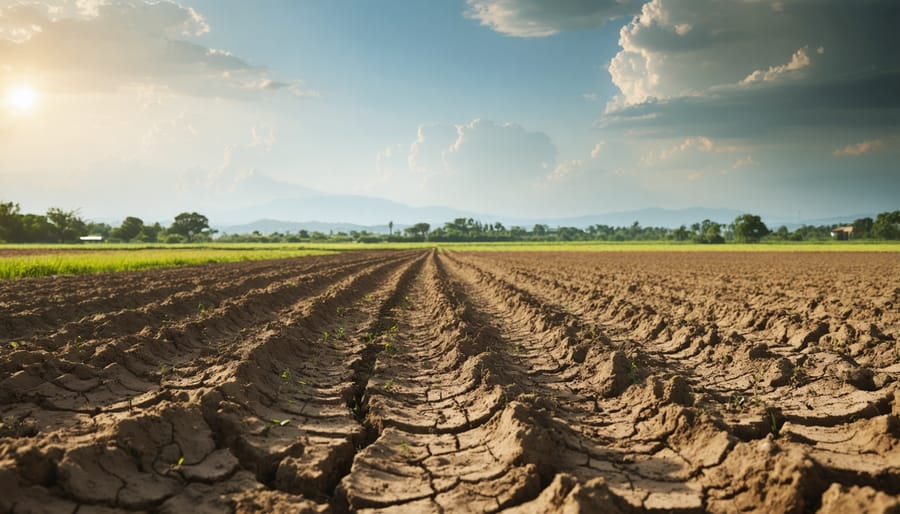
Drought-prone agricultural land faces challenges securing financing as AI models predict increasing water scarcity in vulnerable regions.
The Farm That Was Too Dry
Maria Rodriguez had farmed the same land in California’s Central Valley for twenty years, but when she approached her bank for an equipment loan in 2023, something unexpected happened. The AI system analyzing her application flagged her farm as “high risk”—not because of her credit history, which was excellent, but because of predictions she hadn’t even considered.
The algorithm had processed decades of rainfall data, groundwater levels, and regional climate models, concluding that her area faced a 67% probability of severe drought conditions over the next five years. It was like having a meteorologist from the future whispering warnings into the loan officer’s ear. Traditional lending would have approved her application without a second thought, but the AI saw what human eyes couldn’t: invisible storm clouds of risk gathering on the horizon.
Instead of a flat rejection, the system offered Maria an alternative—a smaller loan with a clause for refinancing if she implemented drought-resistant irrigation systems. It wasn’t the answer she wanted, but looking back at the record-breaking drought that hit just eighteen months later, it might have been the answer that saved her farm.
The Beachfront Property Nobody Would Finance
My neighbor Sarah found her dream retirement home last summer—a charming cottage perched on a sandy bluff overlooking the Atlantic, with waves lapping at the beach below. The asking price seemed almost too good, and when she approached her bank for a mortgage, she discovered why.
The bank’s AI system had flagged the property as high-risk, analyzing decades of tide gauge data, erosion rates, and projections for sea level rise. The algorithm calculated that within twenty years, the bluff would retreat significantly, potentially threatening the foundation. It also factored in the likelihood of stronger hurricanes intensifying coastal erosion. Traditional appraisers might have missed these long-term trends, focused instead on comparable sales from recent years.
Sarah eventually found financing through a lender whose AI offered more favorable terms for properties with documented erosion mitigation plans. The difference? One algorithm looked only at risk, while another considered both risk and adaptation strategies—revealing how AI doesn’t just identify climate threats, but increasingly shapes which properties remain financially viable in our changing world.
The Warehouse That Got a Green Light
In Portland, Oregon, a mid-sized distribution company needed to expand their warehouse operations. The owner, Maria Chen, had deliberately chosen a location fifteen feet above the floodplain and away from wildfire corridors—not because she knew about AI risk assessment, but because her grandfather had taught her to “read the land.” When she applied for her expansion loan, the AI system analyzing her application lit up like a Christmas tree in all the right ways. Her warehouse sat in what the algorithms identified as a climate-resilient zone, with robust infrastructure and minimal projected flood risk over the next thirty years. The result? She secured a loan with terms typically reserved for Fortune 500 companies—a full percentage point lower than the regional average. Her monthly savings of $3,200 meant she could invest in solar panels and employee training instead. Sometimes, old wisdom and new technology shake hands and everyone wins.
Why This Matters More Than You Think
The Investment Migration
Money, like water, follows the path of least resistance—and increasingly, AI is charting that course. As algorithms become more sophisticated at predicting climate threats, they’re creating an invisible migration of capital that’s reshaping communities before the floods even arrive.
Think of it like this: your friend tells you their basement floods every spring, but they’re convinced it’s manageable. Would you invest in renovating their home theater down there? Banks face similar decisions, except they’re juggling thousands of properties and need data, not hunches. AI systems now analyze decades of weather patterns, rising sea levels, and wildfire trajectories to identify neighborhoods where that “manageable” risk is actually a ticking time bomb.
The result? A quiet exodus of investment capital. Areas flagged as high-risk find themselves in a lending desert—fewer mortgages approved, higher interest rates, reduced business loans. It’s not a dramatic collapse but rather a slow strangulation of economic opportunity. Coastal Florida communities and wildfire-prone California towns are already experiencing this shift firsthand. The irony is stark: the places that need investment most to adapt to climate change are the ones being systematically denied it, creating a self-fulfilling prophecy of decline.
The Fairness Question
Here’s a scenario that keeps me up at night: imagine two farmers, both facing the same drought conditions. One owns land in a wealthy suburb where AI models have decades of high-resolution weather data and detailed infrastructure records. The other farms in a rural community where data collection has been sparse and inconsistent. When both apply for loans to build irrigation systems, the AI confidently approves the first application—it has plenty of information to work with. But the second? The algorithm flags it as “high risk” simply because it lacks sufficient data to make predictions.
This isn’t hypothetical. It’s already happening, and it reveals a troubling pattern: AI climate risk systems can inadvertently punish communities that have historically been overlooked by data collectors. Think of it like trying to predict someone’s future based solely on their social media presence—if they’ve never had reliable internet access, does that make them inherently risky, or does it just mean we haven’t been paying attention?
The climate justice implications run even deeper. Communities most vulnerable to climate change—often lower-income neighborhoods and developing regions—frequently lack the resources to implement the protective measures that would lower their AI-calculated risk scores. It creates a vicious cycle: those who most need capital to adapt to climate change are least likely to receive it, not because they’re poor investments, but because algorithms haven’t been trained to see their potential.
What Happens Next
The landscape of AI-powered climate risk assessment is moving fast—like watching time-lapse footage of storm clouds gathering on the horizon. Within the next few years, experts predict these systems will become standard practice across most major lending institutions, fundamentally changing how we think about mortgages, business loans, and insurance.
Here’s what that means for you: if you’re planning to buy property, renovate, or start a business, climate resilience is quickly becoming as important as your credit score. Lenders are already developing more sophisticated questions during the application process. They’re asking about flood defenses, building materials, backup power systems, and evacuation routes—details that seemed irrelevant just a decade ago.
The good news? You’re not powerless in this equation. Properties and businesses with documented climate change adaptation measures are starting to unlock better loan terms. Installing hurricane-resistant windows, elevating electrical systems, implementing water management solutions, or switching to fire-resistant landscaping—these practical steps create a paper trail that AI systems recognize favorably. Think of it as climate-proofing not just your property, but your financial future.
Some forward-thinking municipalities are even offering certification programs for climate-resilient buildings, similar to LEED certification for energy efficiency. These credentials could become valuable bargaining chips in loan negotiations.
Financial advisors recommend starting conversations with lenders early—before you need the loan. Ask what climate adaptations they value most. Request transparency about how their AI assesses risk in your specific location. Some borrowers are successfully negotiating conditional approval: “If I complete these resilience upgrades within six months, will my rate improve?”
The technology is still learning, which means there’s a brief window where informed borrowers can get ahead of the curve. The question isn’t whether AI climate risk assessment will affect your financial options—it’s whether you’ll be ready when it does.
We stand at a peculiar crossroads in human history, where lines of code attempt to decipher patterns that took millennia to form. The banker approving your home loan now consults algorithms that read ice cores, ocean currents, and atmospheric rivers—systems that predate civilization itself. It’s like teaching a computer to speak the Earth’s oldest language, one written in shifting coastlines and changing rainfall patterns rather than words.
My grandfather used to say you could tell everything about a place by watching it through the seasons. Today’s AI does something similar, but at a scale he never imagined—processing centuries of climate data in seconds, recognizing patterns invisible to human eyes alone. Yet for all its computational power, the technology ultimately serves an ancient human need: understanding risk, seeking shelter, protecting what we’ve built.
This collision between cutting-edge technology and primordial Earth systems reveals something profound about adaptation. We’re not just using AI to predict climate risk; we’re fundamentally reshaping how money flows through our economy based on the physical realities of our changing planet. Financial institutions that once saw buildings as fixed assets now view them as dynamic entities in conversation with rising seas and intensifying storms.
Perhaps that’s the real revolution—not the algorithms themselves, but our growing recognition that finance cannot exist separate from the physical world that contains it.





Leave a Reply